
Our team often hears from Canadian families who feel overwhelmed by home security options. The challenge usually starts when a loved one begins wandering at night.
We know that finding the right balance between safety and privacy is incredibly difficult.
Data from the Alzheimer Society of Canada shows that roughly 60% of people with dementia will wander at least once. Our goal today is to explain exactly how these tools function without being intrusive.
Let’s look at the data, explore the wandering alert system, how it works, and provide a clear plan for your home.
Sensor-Based, Not Camera-Based
We always recommend starting with a simple door sensor rather than a complex video feed. Exit and wandering alerts work by combining a door sensor with motion sensors placed around the entryway. Our approach respects both the dignity of your family member and the privacy of visiting health workers.
The Winnipeg Regional Health Authority and other Canadian care organizations have strict policies regarding cameras in care settings. We have seen home care services paused simply because a family refused to turn off an indoor video feed. A magnetic contact sensor bypasses this legal headache entirely.
| Feature | Video Cameras | Door & Motion Sensors |
|---|---|---|
| Privacy Compliance | Often violates caregiver privacy rules | Fully compliant with Canadian privacy standards |
| Battery Life | Requires frequent charging or wiring | CR2450 batteries last up to 3 to 6 years |
| Notification Style | Requires active monitoring | Sends automated push notifications |
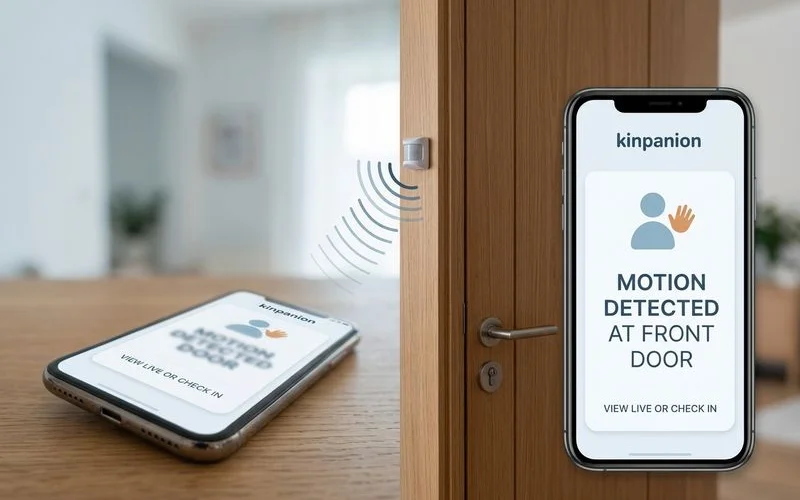
We want you to receive immediate updates without constant screen watching. When the system notices the door open or motion in the entry zone, the family receives a push notification. Our priority is avoiding a live feed of who is coming and going.
Instead, you get a small, calm signal stating the front door opened at 3:12 am. We understand that most families do not want video footage of their parent’s front door. For the broader wandering & dementia prevention service, this exact technology acts as the core sensing layer.
What “Abnormal Hour” Means in Practice
We program the system to build a baseline of normal activity during the first week or two. Your parent’s regular patterns become the picture of an average day. Our setup process notes when they leave for groceries on Tuesday morning or open the door for a Sunday visit.
Exits that fall outside that picture trigger a calm alert.
We flag a few common triggers as abnormal:
- Nighttime exits occurring between 10 pm and 6 am.
- Doors left ajar for more than five minutes.
- Extended daytime absences that break routine.
- Unexpected motion triggering an exit alert dementia notification.
These specific notifications protect your peace of mind. We allow you to configure quiet hours, alert sensitivity, and escalation contacts during concierge setup. Many Canadian homeowners prefer to filter out the noise and only receive critical nighttime alerts.
Our goal is to provide calm signals worth your attention, rather than a barrage of meaningless notifications. The focus stays on actionable information.
What Happens After the Alert
We design the alert to reach your phone with a short, calm description. You can call your parent directly or contact a nearby neighbour. Our system does not make the final decision for you.
The app simply gives you the chance to assess the situation.
We look at response data to understand the real-world impact of these delays.
“Fast response times are critical; MedicAlert’s National Wandering Registry data from 2023 shows that 40 percent of their emergency hotline calls involved dementia-related disorientation.”
We structure this wider dementia-caregiving scenario to give you a complete view of the home. The guide on keeping a parent with dementia safe at home covers how exit alerts combine with bathroom and inactivity coverage. Our tools are not physical locks.
A door sensor wandering setup does not physically prevent a person from leaving. We provide this technology so you can act earlier than you would have otherwise. The early warning is often enough to keep everyone safe.
We hope this breakdown clarifies the technology behind modern safety sensors.
Protecting a loved one requires the right mix of reliable data and practical tools. Our team is ready to help you customize a setup that fits your specific needs.
Start by evaluating your main entryways and contact us to review your options.