Have you ever left the house and suddenly felt a knot in your stomach, wondering if the stove is still on?
We understand exactly how stressful that feeling can be.
This specific Kitchen & Stove Safety worry is a frequent topic in daily conversations for a professional home monitoring service team.
Our team is going to walk you through the exact steps to handle this.
Grab a cup of coffee, and let’s go through it together.
The Burner-Left-On Worry, Honestly
Most families ask about our service because of a single, specific fear regarding a burner left on.
We completely understand that anxiety.
Recent 2026 statistics confirm that unattended cooking is the leading factor in kitchen fires, causing over 40 percent of these emergencies.
Our team views the burner question as partly a stove-design problem and partly a habit-monitoring problem.
You need to know that today, Kinpanion handles the second part well and the first part only conservatively.
We prefer to be completely direct about our scope so you can plan accordingly.
Here are the core facts behind this common worry:
- The statistics: Unattended cooking remains the top cause of home fires across Canada.
- The technology gap: Standard smoke detectors only alert you after smoke is present, not when a burner is simply left on.
- The privacy need: People want safety alerts without placing watched cameras in personal spaces.
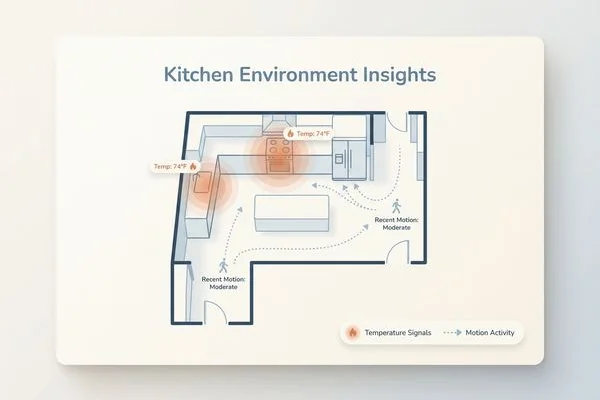
Our current system uses motion and temperature signals to flag unusual kitchen patterns inside the whole-home picture.
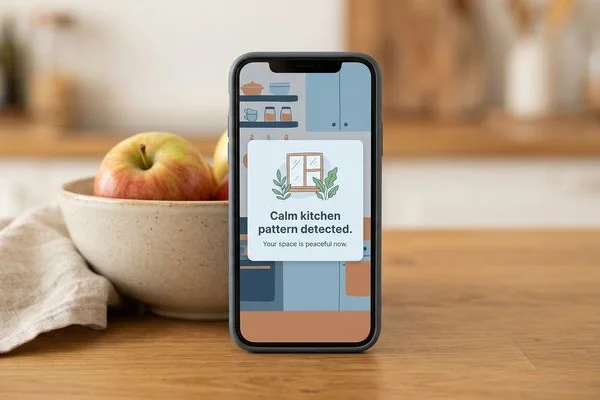
These calm notifications pop up on your phone exactly when you need them.
We deliver this peace of mind without ever installing a camera in the kitchen.
What Kitchen & Stove Safety Signals Look Like in Practice
A baseline of normal forms over the first seven days of use.
We build this initial profile to understand the unique rhythm of your home.
After that first week, the system can flag patterns like sustained heat with no nearby movement.
Our sensors might also notice a quiet kitchen during a window your parent normally cooks in.
Fire safety data from 2025 shows that nearly 70 percent of cooking fires happen between 5 p.m. and 8 p.m.
We pay special attention to these high-risk evening hours.
None of these alerts is a final verdict.
Our goal is to provide calm signals worth a gentle, “Hey Mum, what’s going on for lunch today?” call.
This is exactly the kind of check-in families want to make anyway.
We integrate these kitchen signals alongside falls, bathroom use, and inactivity coverage.
The Alzheimer Society of Canada notes that changes in routine often signal a need for more support.
Our whole-home context helps you see those changes clearly without being intrusive.
To illustrate how this works, consider the difference between a single alert and a combined picture:
| Isolated Kitchen Signal | Whole-Home Context | What It Might Mean |
|---|---|---|
| Quiet kitchen at 12:00 PM | Normal activity in the living room | Taking a nap or eating a cold lunch. |
| Sustained heat detected | Motion detected right next to the stove | Actively boiling water or cooking a long meal. |
| Quiet kitchen at 12:00 PM | Quiet hallway plus a long bathroom presence | A potential fall or health issue requiring a check-in. |
A quiet kitchen at lunchtime might be absolutely nothing to worry about.
We know that a quiet kitchen, combined with a quiet hallway and a long bathroom presence, paints a very different picture.
Whole-home context truly earns its keep in those exact moments.
What the System Won’t Do Today
Full stove auto-shutoff is currently an open item on our development list.
We have a clear roadmap for the future, but we refuse to ship a promise we cannot keep.
Many hardware solutions already exist if your situation requires a hard cutoff today.
Our team highly recommends looking into dedicated auto-shutoff appliances if you are managing significant memory decline.
For example, the Canadian-certified iGuardStove uses a motion sensor to automatically cut power to the stove after five minutes of inactivity.
We believe pairing our kitchen signals with a device like that creates an incredibly strong safety net.
Here are a few pro-tips from occupational therapists for building a layered safety approach:
- Install an auto-shutoff device: Tools like the iGuardStove or FireAvert physically cut the power or gas when a person leaves the room.
- Upgrade your smoke alarms: Ensure you have interconnected, photoelectric smoke alarms near, but not directly inside, the kitchen to avoid false alarms.
- Remove physical hazards: A simple insider trick is to pull the stove knobs off entirely when the stove is not in use.
- Schedule regular check-ins: Use our system’s alerts to time your daily concierge calls perfectly.
Our company would rather be a highly useful piece of a layered approach than oversell our capabilities.
A single piece of technology will never replace the value of human connection and physical safety tools.
We encourage you to combine environmental monitoring with strong physical safeguards.
Where This Fits With the Whole-Home Picture
Most families who care about kitchen safety also care deeply about preventing falls.
We notice that many of the underlying daily patterns overlap significantly.
Statistics show that one in four older adults experiences a fall each year.
Our system looks at the entire environment to spot these connected risks.
“Creating a safe home environment means looking at the whole picture, from the kitchen to the hallways, to prevent accidents before they happen.”
We designed our services to complement each other perfectly, providing a strong safety net.
You can learn more about how we handle physical safety on our main service page for Privacy-First Fall Detection.
Our team is always ready to help you connect these features.
For cognitive-decline situations where the cooking worry tends to amplify, please see our guide on Wandering & Dementia Prevention.
Protecting your loved ones requires a smart approach to Kitchen & Stove Safety.
We invite you to reach out to our team today to discuss your specific home layout.
Setting up a customized plan is the best way to secure your peace of mind.