
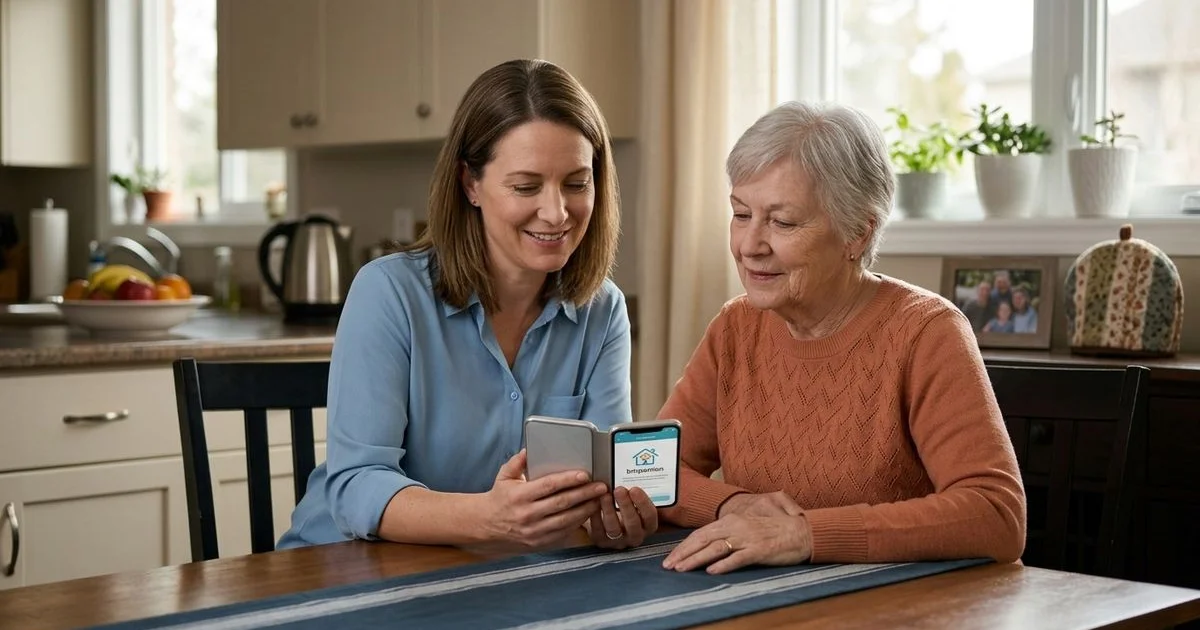
What “Passive Whole-Home Monitoring” Actually Means
For families wondering how does in-home senior monitoring work, the answer lies in a deliberately calm category where smart sensors track daily routines and detect emergencies without requiring cameras or wearable devices. We know from experience that user compliance is the biggest hurdle in senior safety.
Families frequently purchase alert pendants, only to find them abandoned on a dresser when an emergency happens.
A June 2026 Vivalink survey confirmed this exact trend, revealing that over half of patients stop using wearable monitors simply because of physical discomfort or skin irritation. That friction is why a passive approach is so vital.
If you want the privacy side in detail, exploring monitoring without watching walks through how on-device detection means your phone gets an alert event, not a live video feed.
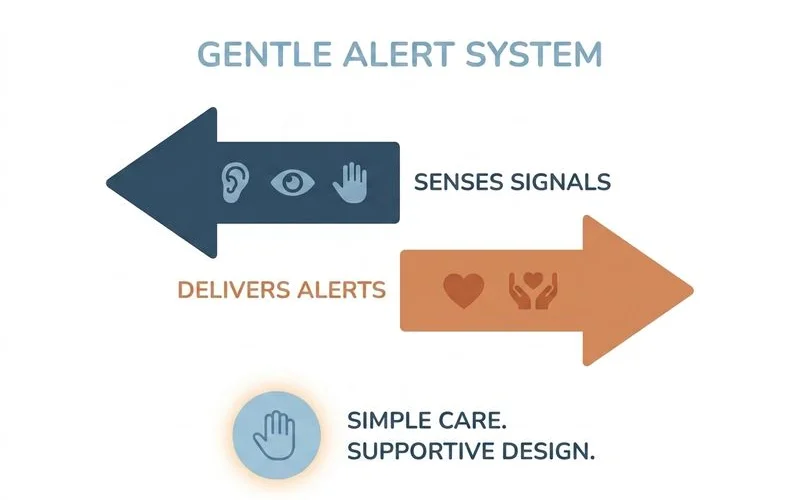
The entire framework of passive senior monitoring relies on three quiet steps:
- Sense: Advanced 60-GHz radar and motion sensors map the room in 3D to recognize the specific velocity of a fall.
- Alert: The system automatically pushes a notification to a family member’s phone.
- Set up for you: The equipment arrives pre-configured and ready to plug in.
We ensure your parent never has to push a button, wear a lanyard, or remember to charge a battery. Data from a recent Canadian physiotherapy study shows that falls account for 85% of injury-related hospitalizations among older adults, and half of those happen right at home. A no wearable fall alert system drastically cuts down the response time during those critical in-home events.
What Arrives in the Kit (and How Concierge Setup Works)
A standard Kinpanion kit arrives at your home within a few days of ordering, packed with a central hub, motion and door sensors, a sleep pad, and a help button. We pre-configure and label every single piece of hardware before it ships. This means nothing requires soldering, drilling, or an expensive truck-roll installation.
The concierge setup process is a guided phone call where a professional walks you through the physical placement of each device. We stay on the line to help you connect the hub to the home Wi-Fi and set up the family smartphone app. Most families complete the physical installation and go live within an hour.
Connectivity is a common roadblock, especially in historic Canadian neighborhoods. We have seen how thick plaster and lath walls in older London areas like Wortley Village and Old South can severely block a standard router signal. Upgrading to a dual-band mesh Wi-Fi network is a smart choice for homes built before 1940.
| Network Type | Best For | Signal Penetration through Plaster |
|---|---|---|
| Standard Router | Small modern homes | Poor (Frequent sensor dropouts) |
| Mesh Wi-Fi System | Historic properties | Excellent (Consistent coverage) |
We also provide a short script for the initial conversation with your parent to make the transition smoother. Presenting the kit as a tool that they control keeps the day-to-day feeling normal and completely eliminates any stigma.
Whole-Home Breadth, in One App
The true power of this system lies in whole home senior monitoring, connecting isolated data points from the bedroom, bathroom, and hallways into one clear dashboard. We consolidate sleep trends, bathroom frequency, and unusual inactivity into a single app interface.
A solitary camera or a single motion sensor only provides context for one room at one specific moment. A passive monitoring network quietly notices the difference between a normal night of sleep and someone wandering the house at 3:00 AM. We rely on the breadth of this data to paint a comprehensive picture of your parent’s well-being.
“A passive monitoring system focuses on patterns and breadth, quietly noticing what matters without compromising personal dignity.”
This holistic approach is crucial because the system is designed to support aging in place, not to act as a substitute for clinical care or in-person check-ins. Where families want the safety side specifically, fall detection is the main page for exploring our advanced capabilities. Bathroom and bed-leaving sensors live alongside that core detection technology to provide context before an emergency happens.
When setting up a home environment, avoiding common pitfalls makes a massive difference in long-term success. We frequently warn families about these three specific monitoring mistakes:
- Ignoring bathroom routines: A sudden spike in late-night bathroom trips is often the first hidden sign of an infection or illness.
- Relying on one sensor: Placing a fall sensor only in the living room leaves the highest-risk areas completely unprotected.
- Forgetting the conversation: Installing equipment without explaining how it protects privacy breeds resentment and damages trust.
The conversation with your parent matters just as much as the physical hardware. We design every alert to be calm and unobtrusive, ensuring the daily routine feels perfectly normal. Framing the system as quiet help rather than a medical verdict is the entire point.
Understanding how does in-home senior monitoring work is the first step toward giving your parent the independence they deserve. We encourage you to review the kit options today and start planning that important conversation with your family.