
We talk to concerned families every week as a professional service team dedicated to keeping aging parents safe at home. The search for the best camera free senior monitoring system ontario provides can feel overwhelming.
Public Health Agency of Canada statistics show that about one-third of seniors fall each year.
Those numbers make finding a reliable safety net an urgent priority. Let us look at the data, what it actually tells us, and explore a few practical ways to respond.
Three Categories, Three Designs
When families start looking into safety for an aging parent, they usually arrive at three options. You can choose a consumer camera like Nest or Ring, a medical-alert pendant like Lifeline, or whole-home in-home monitoring like Kinpanion. They all promise help.
They differ significantly in what they ask of your parent and what they give you in return.
This guide compares them honestly. We want to help you pick what fits instead of trying to win a sales argument. For a head-to-head on the wearable question specifically, our fall detection camera vs medical-alert pendant breakdown goes deeper on that one comparison. Our team reviews the camera vs pendant elderly options regularly to keep this information updated.
Consumer Camera: Watched Feed, Bedroom Trade-Off
A consumer camera gives you a live video feed of specific rooms so you can check in at any time. This setup offers a familiar interface and is cheap to start.
Some models provide basic motion alerts. Our experience shows these cameras work well for front porches, but they fall short for elder care.
A 2024 JMIR study on smart home surveillance found that 87% of adults over 50 reported major privacy concerns with recording devices. People consistently avoid placing cameras in private spaces for several reasons:
- Bedrooms are off-limits due to dignity concerns.
- Bathrooms remain unmonitored despite being high-risk areas for slips.
- Seniors frequently unplug devices when they feel constantly watched.
Security cameras only record a fall after the fact. They do not detect an emergency to alert anyone in real time.
If your goal is real-time safety help for an aging parent, a consumer camera is the wrong tool. It works great for package delivery alerts.
Medical-Alert Pendant: Help, But Only When Worn
A medical-alert pendant is the classic solution for senior safety. You get a round device on a lanyard or wristband that connects to a call centre when pressed.
This direct and simple approach is well-established. Lifeline Canada systems currently cost between $35 and $50 CAD per month, plus setup fees for the hardware.
The failure modes for these wearables are just as well-established. A pendant only provides protection if specific conditions are met:
- The senior must actively wear it, even during showers.
- The user must remain conscious to press the button after an incident.
- The individual must overcome the stigma of wearing a visible medical device.
We see pendants left on bedside tables constantly because of this stigma. The help provided is just a phone call. You get no whole-home context, no early signal, and nothing to monitor an unsafe exit at 3 am.

A delay in receiving help can be catastrophic. Leaving a senior on the floor for just 30 minutes significantly increases the risk of dehydration and muscle breakdown.
For some active parents who reliably wear the pendant, this category works. For most families we assist, the failure modes outweigh the simplicity.
Whole-Home In-Home Monitoring: Passive, Privacy-First
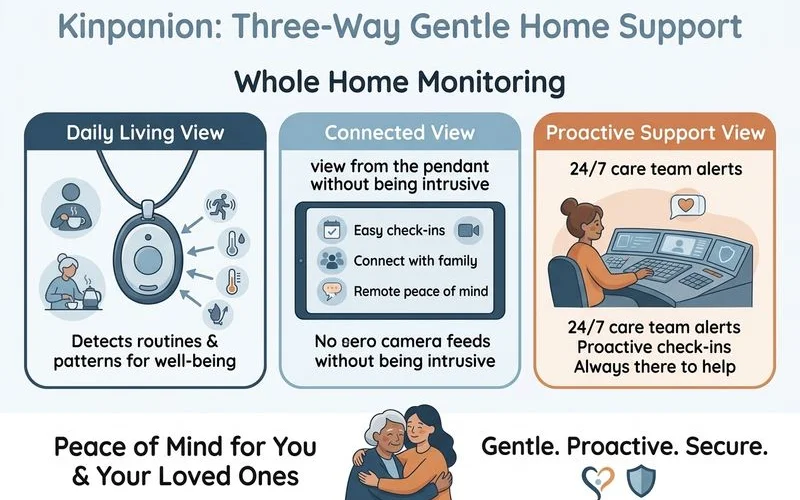
In-home monitoring sits in a different category entirely. Systems like Kinpanion use passive detection across the whole home with no wearables and no watched cameras.
Sensors quietly notice falls, exits, and bathroom visits. The Kinpanion camera does its work on the device itself and surfaces a privacy-safe event rather than a video feed.
The family receives a calm signal on their phone when something is actually worth knowing about. Our favorite feature is the complete lack of equipment for your parent to wear.
Passive fall detection systems in Ontario typically cost between $30 and $80 CAD monthly depending on the hardware tier. This investment provides several distinct advantages:
- No physical buttons or lanyards required.
- Zero live video feeds to compromise privacy.
- Continuous monitoring across multiple rooms.
- Proactive detection of events rather than delayed recordings.
The honest downsides include the need for reliable home Wi-Fi. This technology supports rather than replaces in-person care.
It also requires a monthly financial commitment. We use an all-in lease that includes a real 7-day free trial. See our pricing for exact details.
This category fits perfectly when the goal is to keep a parent independent at home. You gain quiet help in the background and a calm phone for the family.
Which Should You Pick?
The right choice depends entirely on your specific worries and your parent’s daily habits. We break the decision down into three quick frames.
If your parent is active and reliably wears a pendant, a medical alert is the smallest cost path. This works best when your main worry is an acute incident during the day.
If your parent refuses anything in the bedroom and you only want package-style awareness, a consumer camera is fine. Just keep it restricted to non-private spaces.
Selecting the Best Camera Free Senior Monitoring System Ontario Has Available
If your worry covers the whole home, you need a different approach. Falls, exits, bathrooms, and night-time wandering require detection without surveillance. Whole-home in-home monitoring is the ideal category for this comprehensive coverage.
To make the comparison clearer, here is how the three options stack up:
| System Type | Average Canadian Cost | Privacy Level | Wearable Required? |
|---|---|---|---|
| Consumer Camera | $100-$250 CAD (One-time) | Low (Live video feed) | No |
| Medical-Alert Pendant | $35-$50 CAD / month | High (Button only) | Yes |
| In-Home Monitoring | $30-$80 CAD / month | High (Passive sensors) | No |
The Kinpanion-specific case lives on our privacy-first fall detection page. Take a look to see how passive sensing changes the daily routine.
The in home senior monitoring comparison always comes down to matching the tool to the reality of the user. You need a system your parent will accept and a solution that gives you genuine peace of mind.
Finding the best camera free senior monitoring system ontario offers might take a little research, but the safety it provides is invaluable.
Take five minutes today to discuss these three options with your family and decide which approach fits your home best.