
Many property owners blur the lines between emergency response and daily health tracking. That confusion often creates a dangerous false sense of security.
We see this issue surface repeatedly when families evaluate sleep wellness monitoring vs fall safety alerts. Clarifying the difference between a proactive health metric and a reactive emergency net is the most important step in choosing a system.
Let’s examine the data behind these two approaches, clarify their distinct roles, and explore practical ways to find the right fit for your property.
The Bright Line We Care About
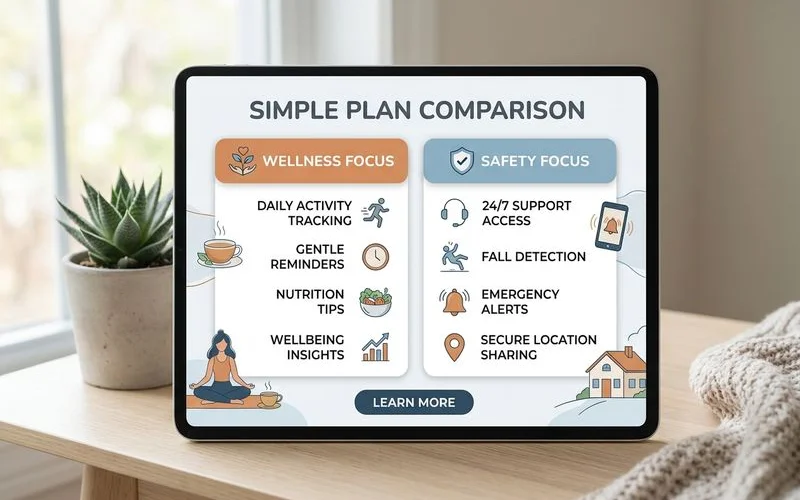
Kinpanion has two strictly distinct categories of plans. The first focuses entirely on immediate safety, which includes the hub plans, the Camera plan, and the whole-home Complete system. These options send real-time alerts when something acute happens, like a sudden fall, an unsafe exit, or an unusual bathroom presence.
Our team holds this boundary firmly. The Sleep plan focuses entirely on wellness and never provides fall protection. It carries absolutely no safety alerts and cannot replace a dedicated safety plan.
A wellness layer pretending to be a safety net leads families to rely on it for emergencies it simply cannot handle. We prefer to be completely transparent about this scope, rather than risk a customer incorrectly assuming a sleep pad will catch a fall.
According to a 2026 report from the Public Health Agency of Canada, falls represent the leading cause of injury-related hospitalizations for Canadian seniors, generating an annual fiscal burden exceeding $10.3 billion.
These acute, high-risk situations require the immediate intervention that only a dedicated safety plan offers. On the other hand, a wellness only sleep monitoring routine serves a completely different, yet highly valuable, purpose.
A 2026 study from the Canadian Community Health Survey indicates that nearly 48% of Canadian adults now report trouble sleeping. The Sleep plan builds a calm, long-term picture of these sleep and rhythm trends over time, without ever triggering a disruptive alert. Our guide on what sleep and vitals trends can and can’t tell you sets honest expectations for what that picture reveals.
For the broader wellness layer this is a piece of, sleep & wellness trends is the main page. Those looking for the broader safety service will find privacy-first fall detection to be the main resource page.
When Each Plan Fits
Safety plans fit perfectly when a family requires real-time visibility on acute moments, such as a severe fall, an unsafe property exit, or a concerning bathroom alert. These are the active systems that will wake you up at 3:00 AM if an emergency occurs. The Camera plan and hub plans are explicitly designed for this rapid response, while the whole-home Complete system combines them for maximum coverage.
We often recommend the Sleep plan as an insightful wellness layer added on top of a foundational safety plan. It also functions wonderfully on its own for families who want gentle wellness visibility without the active safety monitoring.
Some households with a parent who already possesses excellent acute emergency coverage from another source frequently choose this combination. It simply is not the right choice as a standalone safety solution.
Understanding the specific use case is critical for avoiding a dangerous false sense of security. Nearly 40% of Canadians now own at least one wearable or digital health tracking device, according to 2025 consumer market data. These consumer devices provide excellent baseline data, but they lack the environmental context to dispatch immediate help during a severe incident at home.
Consider these specific scenarios when deciding on an approach:
- A history of falls: Immediate safety alerts are absolutely required.
- Wandering or unsafe exits: Door and motion sensors provide critical intervention.
- Curiosity about rest patterns: A wellness-only sleep monitoring setup works perfectly.
- Pre-existing medical alert pendant: Comparing a sleep plan vs safety plan kinpanion setup reveals that adding a wellness module provides valuable long-term data without overlapping existing emergency calls.
How to Choose
A simple framework makes choosing between sleep wellness monitoring vs fall safety alerts much easier. If your primary worry involves a fall, an unexpected exit, or an acute health incident, you absolutely want a safety plan. You have three main options:
- The Camera plan ($99/mo): The most common starting point for fall-focused households.
- The hub plans ($49/mo): Best when door and motion coverage takes priority.
- Whole-home Complete ($139/mo): The comprehensive option for total property coverage.
If your primary interest involves wellness visibility, such as sleep quality, daily rhythms, or recovery tracking, you definitely want the Sleep plan. Most families choose to add it directly on top of a foundational safety plan. Whole-home Complete+ bundles everything together for $188 per month, offering a complete picture of both security and health.
We always suggest starting with the safety side if you feel uncertain about your initial choice. Wellness features can easily be added later, but safety cannot be retrofitted onto a wellness-only plan. The standard 7-day free trial generously covers either path, ensuring you can thoroughly test the fit before making a long-term commitment.
Making the right choice depends heavily on your immediate environment and specific risk factors. A 2025 report from the BC Injury Research and Prevention Unit noted that older adult falls resulted in $1.41 billion in healthcare expenses in British Columbia alone. This data highlights the severe financial and physical cost of inadequate safety measures.
Here is a quick reference guide to help solidify your final choice:
| Plan Category | Primary Function | Ideal User Profile | Emergency Alerts |
|---|---|---|---|
| Safety Focused | Acute incident detection | High fall risk, history of wandering | Yes (Immediate) |
| Wellness Only | Long-term rest tracking | Curious about sleep rhythms | None |
| Combined System | Full safety plus health data | Wants total visibility | Yes (Immediate) |
Taking a proactive stance on home protection ensures your space remains secure, comfortable, and well-suited to your needs. Start by accurately assessing the most pressing risk, select the corresponding tier, and activate your 7-day free trial today to let the numbers guide your future adjustments.