

The Short, Honest Answer: Does Fall Detection Camera Show Video?
Does fall detection camera show video? No, there is absolutely no live feed of your parent’s bedroom. Our professional service team can confirm that footage is never available on the family’s phone, in the cloud, or to the staff at Kinpanion.
Falls are responsible for about 85 percent of hospitalizations for Canadian seniors, making reliable detection critical. We know from experience that privacy fears often prevent families from installing these life-saving tools. Families usually have three primary questions during an installation:
- Who has access to the data?
- Where are the files stored?
- Is someone watching live?
The app renders a privacy-safe stick figure of the moment a fall or distress was detected, and that is the extent of the visual data. We deliberately refuse to hide the fact that a physical lens is present.
A no video bedroom camera setup is simply a camera you never watch, by design.
Our team knows that transparency prevents the device from ending up in a drawer. That is the direct answer to the question families ask us first. For the wider design that makes this privacy possible, monitoring without watching walks through exactly how on-device detection actually functions.
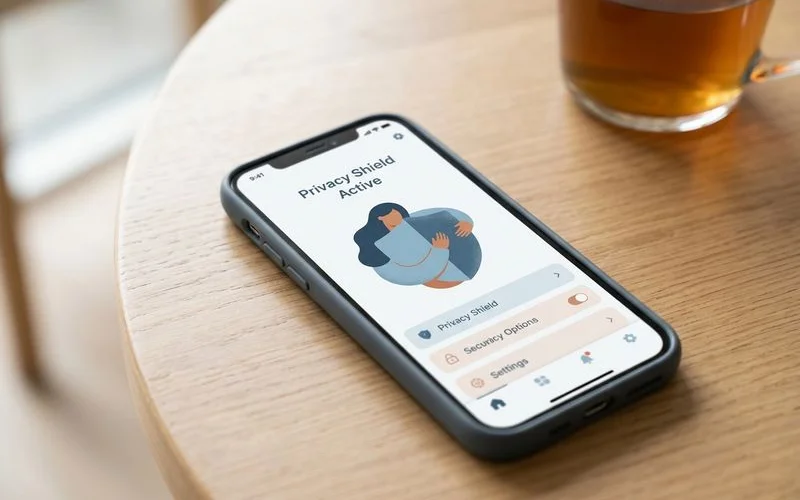
What Is Captured, and How It’s Protected
The system captures a specific event, like a fall, and records the time alongside a privacy-safe abstract figure to show the approximate body position. Our hardware processes all vision data entirely on the device itself. The home and the cloud do not exchange raw video of the room under any circumstances.
Edge AI technology completes all complex behavioural interpretations instantaneously within the front-end device. We secure the connection between the device and the family’s phone using AES-256 encryption. This is the exact data protection standard required by major Canadian banks and healthcare portals.
Strict Canadian Compliance Standards
Devices are strictly leased, meaning they are reclaimed, factory-wiped, and all derived health data is purged upon cancellation. Our team refuses to claim certifications we have not actually earned. You will not see us advertise HIPAA compliance, because that is a United States framework irrelevant to Canadian operations.
This technology operates strictly under federal PIPEDA regulations and Ontario’s PHIPA guidelines to protect personal health information. We designed the architecture to meet the data minimization requirements set by the Office of the Privacy Commissioner of Canada. The table below illustrates how our approach differs from standard security hardware.
| Feature | Traditional Security Camera | Kinpanion Fall Detection |
|---|---|---|
| Data Processing | Sends raw video to the cloud | Edge AI processes locally |
| Visual Output | Live room feed | Stick-figure pose estimation |
| Canadian Compliance | Often lacks PHIPA safeguards | Fully PIPEDA & PHIPA compliant |
Our focus on fall detection privacy ensures the system remains a helpful tool rather than a surveillance threat. For the broader Kinpanion design that this answers a piece of, privacy-first fall detection is the main page to review.
Why “Camera You Never Watch” Beats “Not a Camera”
We use the exact phrase “a camera you never watch” because it is truthful and sets the right expectation. A small phrasing decision makes the difference between a system that stays plugged in and one that gets discarded. Our installers know that claiming “it is not a camera” immediately destroys trust the moment a parent spots the physical lens.
Academic studies using the Unified Theory of Acceptance and Use of Technology confirm that older adults quickly reject monitoring devices if they feel misled. We frequently see families make these common communication errors during setup:
- Hiding the device behind books or plants.
- Telling the parent it is just a motion sensor.
- Avoiding conversations about who can see the alerts.
- Dismissing valid concerns about data storage.
The honest framing earns a collaborative conversation with your parent.
Our goal is continuous safety, and clear communication is the only way to achieve it. Once she sees the app shows a privacy-safe rendering of the moment rather than a live feed, the device tends to stay where it was placed. If you’re curious about the mechanics behind that rendering, our guide on how camera-free fall detection works walks through the on-device steps.
This direct approach answers the bedroom surveillance question without relying on deceptive marketing words. We built this hardware to provide peace of mind for both you and your aging parents. The next time someone asks you, does fall detection camera show video, you can confidently explain the edge processing and privacy safeguards that make it a safe choice. Start by having an open, honest conversation with your parent about how this technology protects their privacy while keeping them secure.