
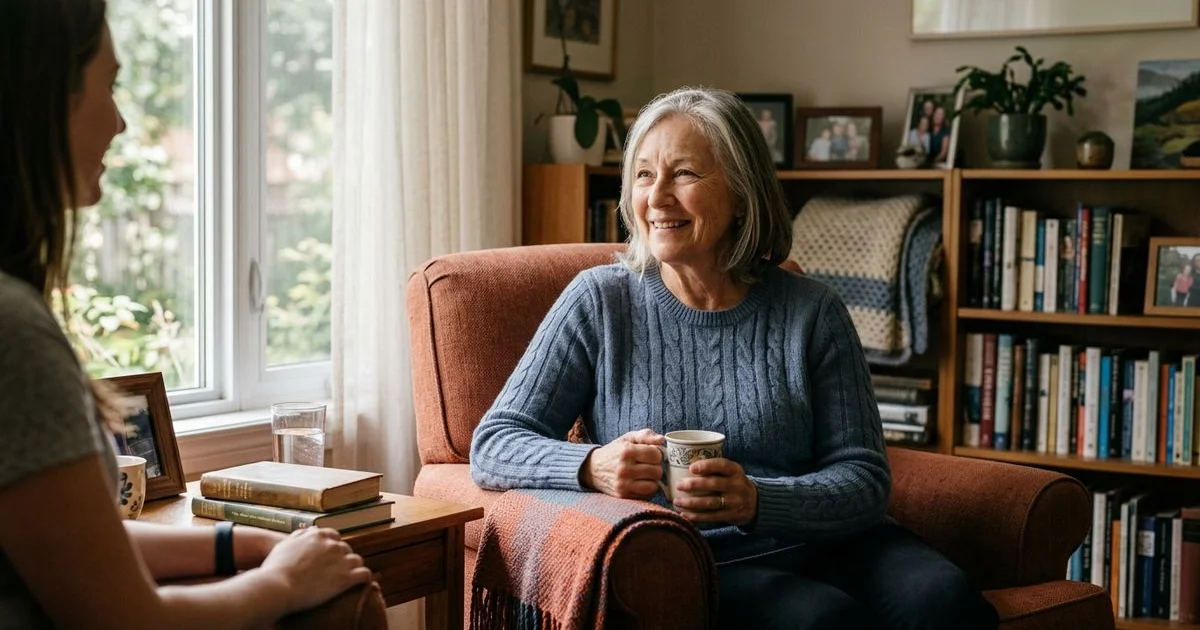
We know that choosing the right safety technology for an aging family member feels like walking a tightrope between security and personal space.
The reality is that traditional surveillance often feels intrusive to independent homeowners. Our team focuses on privacy-safe solutions because the Public Health Agency of Canada reports that falls remain the leading cause of injury-related hospitalizations among seniors.
This creates a clear need for practical safety nets.
We will explain the mechanics of non-wearable fall detection how it works, detail the alert process, and outline the network requirements you need to know. Let’s explore the data behind these systems and review a few practical ways to protect your property and loved ones.
What “Detection, Not Recording” Means
Detection means the system identifies an event in real-time without ever storing or streaming live video of the room. Our system uses edge AI processing to analyze motion directly on the device itself.
The standard camera-monitoring model records footage for later review, which fails to protect user privacy. Our non-wearable fall detection how it works model completely flips that script.
Local data processing provides three distinct advantages for homeowners:
- Zero Cloud Storage: The device processes vision data locally using machine learning algorithms.
- Immediate Action: On device fall detection allows families to act in real time during a late-night emergency.
- Risk Mitigation: A 2024 cybersecurity report highlighted severe vulnerabilities in cloud-reliant cameras like the AVTECH IP models.
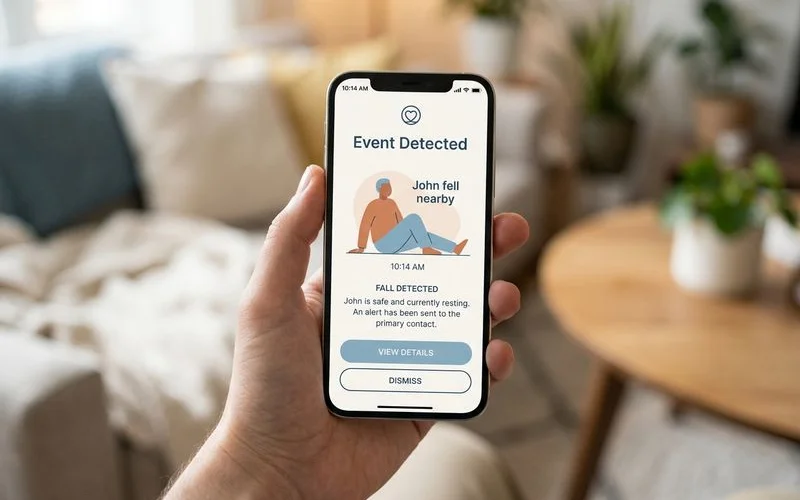
We ensure families receive a real-time event notification with a short description and a privacy-safe stick figure of the moment. There is no live feed and no recorded video of the bedroom for anyone to watch later. We cover the broader design philosophy on the privacy-first fall detection main page.
What the Family Actually Receives
When an incident occurs, the family immediately receives a push notification, a rendering of the person’s posture, and an automated voice call. Our system triggers these three actions calmly and quickly to ensure you never miss a critical alert.
A privacy-safe stick figure of the moment renders in the mobile app. We provide this abstract visual so you can see the rough position without viewing a camera feed. A fall voice-escalation call acts as a backup if your phone sits on silent mode.
Our setup process allows you to customize your response options. Options include calling the parent, dismissing a false alarm, or escalating the situation to a neighbour.
| Alert Type | Recommended Action | Notification Method |
|---|---|---|
| High Confidence Fall | Call emergency services or neighbour | Phone call and push notification |
| Potential Slump | Check in via phone call | Push notification with visual rendering |
| False Alarm | Dismiss alert in the app | Silent app log entry |
We tune these alerts to favour calm over noise. Missing a minor movement is better than waking a homeowner for nothing.
We configure alert sensitivity and escalation contacts during your initial concierge setup. Market data from Grand View Research shows that automatic alert systems accounted for over 60 percent of the industry revenue in 2025. Our team utilizes this automated approach to reduce caregiver fatigue. Users can adjust all sensitivity settings at any point through the app interface.
Why It Covers the Whole Home
Whole-home coverage means using a network of specific sensors throughout the house rather than relying on a single device. Our fall detection without camera feed strategy creates a comprehensive safety net across multiple rooms.
A single device only sees one specific area. We typically install the main processing unit in the room where the individual spends the most time. Secondary sensors fill the gaps in hallways and entryways.
We deploy three main types of supplementary sensors:
- Door and Motion Tracking: Placed at entryways to monitor activity.
- Presence Detection: Opt-in devices for high-risk areas like the bathroom.
- Bed-Leaving Monitors: Pressure-sensitive tools for the bedroom.
Combining these data points builds a calm, accurate picture of the environment. Our documentation tackles the common question, does the camera show video of her bedroom?, directly and transparently.
The short version is that the equipment never captures raw video. We utilize this sensor fusion approach because 2026 data on ambient assisted living proves multi-sensor setups reduce false positives. This combination keeps the resident safe without compromising their dignity.
Honest About Wi-Fi and Scope
The scope of this system relies entirely on a functional Wi-Fi connection and home-based networking. We will never pretend the equipment works during a full internet outage.
Canadian home networks experience periodic disruptions. Our concierge setup team walks the home’s network to evaluate its strength before installation. The Canadian Radio-television and Telecommunications Commission (CRTC) target of 50 Mbps download speeds provides a good baseline for reliable connectivity.
We test the local bandwidth against these standards to ensure the hardware functions properly. The system will not replace traditional care methods, including the following supports:
- Clinical medical care from nurses or doctors.
- In-person wellness check-ins from family.
- Routine visits from neighbours or friends.
Our technology supports those caregivers rather than acting as a substitute. Honest framing sets the right expectations for families managing independent living.
We know that establishing clear boundaries makes the entire safety net more effective. A reliable connection guarantees those critical push notifications arrive when seconds matter.
We encourage you to review your home network speeds and contact our support team to schedule a concierge setup. Taking this step ensures your property remains a secure, private environment.